If you’ve ever walked out the door on a crisp morning, fully rugged up, only to be sweating through your layers by midday you already understand the challenge of dressing for Australian weather. It’s not just a Melbourne thing, either. Across the country, temperatures can swing dramatically within a single day, and finding clothing that holds up through those shifts is harder than it sounds. That’s exactly why so many Australians have quietly made merino wool a staple whether they’re reaching for beanies for women on a frosty school run or packing a lightweight scarf for a weekend trip down the coast.
Merino wool isn’t a trend. It’s a practical answer to a genuinely tricky problem.
The Real Problem With Dressing for Australian Weather
Before we get into the fabric itself, it’s worth naming the actual frustration.
Most winter clothing is designed to solve one problem: keeping you warm when it’s cold. That works fine in climates where it stays cold. But in Australia, you’re not dealing with a steady cold, you’re dealing with constant change. A 7-degree morning in June can push to 19 degrees by early afternoon in many parts of the country. Then the sun drops, a cool wind comes in off the bay or the hills, and you’re cold again.
Heavy wool jumpers, thick fleece jackets, and padded coats do a fine job in the morning. But by lunchtime, you’ve either tied them around your waist or shoved them into a bag. And if you’ve packed light which most people try to do you’re either overdressed or underdressed for half the day.
The better solution isn’t more layers. It’s smarter.
What Actually Makes Merino Different
The name “merino” comes from the Merino sheep breed, originally from Spain and now raised extensively across Australia and New Zealand. What sets their fleece apart is the fineness of each individual fibre.
Standard wool fibres are coarse enough that they catch on skin and cause that familiar prickle. Merino fibres are significantly finer fine enough that they bend on contact rather than scratching. The result is a fabric that sits comfortably directly against skin, without the itch that puts most people off wool entirely.But softness is only part of the story.
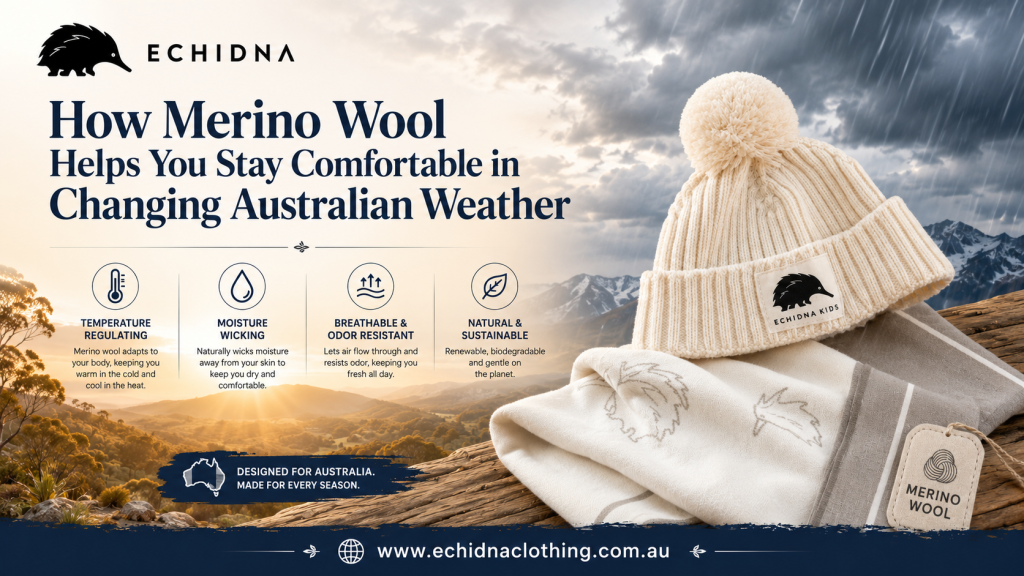
The fibre structure of merino wool creates tiny air pockets throughout the fabric. These pockets trap warmth when you need insulation, but they also allow heat and moisture vapour to pass through when your body temperature rises. It’s a passive, natural regulation system with no technology required, no special treatment. Just the way the fibre is built.
This is what separates merino from synthetics. A polyester beanie keeps your head warm, but it doesn’t breathe. Once you warm up, heat and moisture have nowhere to go, and you end up damp and uncomfortable. Merino adjusts with you.
Beanies: A Small Accessory With a Big Impact
A lot of heat escapes through your head and neck far more than most people account for when layering up. A well-made beanie isn’t just a finishing touch on a winter outfit; it genuinely affects how warm your whole body feels.
What’s changed in recent years is what people expect from a beanie. The old thick-knit, pull-down-over-your-ears style still has its place, but there’s a growing preference for something lighter and more versatile. Something you can toss in a bag when you don’t need it, pull on when the temperature drops, and not feel like you’re wearing a helmet.
That’s where merino delivers. For anyone shopping mens beanies Australia wide, the options in merino wool have expanded significantly and the quality has improved alongside demand. A merino beanie sits close without being tight, keeps warmth in without trapping it, and doesn’t leave your hair looking like you’ve been through a wind tunnel.
The same applies on the other side of the market. Womens beanies Australia shoppers tend to prioritise fit and feel as much as warmth, and merino satisfies both. It holds its shape well, doesn’t pill quickly with regular wear, and stays soft after washing which matters when something gets worn almost daily through the cooler months.
Why Merino Wool Scarves Work Year-Round
Here’s something that surprises people: a good merino scarf isn’t just useful in winter.
Because the fabric breathes so well, it doesn’t trap heat the way a heavy knit or synthetic scarf does. Worn loosely, it adds just enough warmth to take the edge off a cool morning or a draughty air-conditioned office without making you feel like you’re in a sauna by 10am.
A merino wool scarf is genuinely useful across the shoulder seasons March through May, and again in September and October when temperatures are uncertain and you’d rather not carry a jacket. It also packs flat, which matters for anyone travelling or commuting.
For those looking specifically at an Australian merino wool scarf, it’s worth noting that locally sourced merino wool tends to have strong quality standards, partly because Australian wool producers have long supplied premium international markets. You’re often getting fibre that’s been graded carefully, spun consistently, and finished to last.
If you’re buying as a gift or investing in something you’ll use regularly, it’s the kind of purchase that holds up.
Merino for Men: More Than Just a Cold-Weather Fix
There’s a perception that merino wool is mostly a niche interest, something hikers and outdoor enthusiasts care about, but not everyday wear for most men.
That perception is changing. Mens wool beanies and merino accessories have moved firmly into mainstream workwear and weekend wear, partly because the fabric performs so well in urban settings. Commuters who cycle or walk to work appreciate something that handles sweat without becoming uncomfortable. People who work outdoors tradies, landscapers, farmers have trusted merino for years because it insulates even when damp and doesn’t restrict movement.
For men who want practical cold-weather gear that doesn’t require constant layer-swapping throughout the day, merino wool covers a lot of ground without a lot of fuss.
Merino for Babies: Where Comfort Really Matters
Adults can tell you when they’re too hot or too cold. Babies can’t and they also can’t regulate their own body temperature effectively, which means the fabrics they wear do more work than most people realise.
Merino wool has a long track record in baby clothing precisely because it handles the regulation that tiny bodies can’t do on their own. It keeps warmth in when temperatures drop overnight, lets excess heat escape before a baby gets flushed or sweaty, and sits gently against newborn skin without causing irritation.
For parents looking for newborn gifts that are actually useful, merino wool items, baby beanies, blankets, and first layers tend to be deeply appreciated. They’re not the kind of thing parents always buy for themselves, but once they start using merino they tend to stick with it.
Caring for Merino Wool
The main thing that puts people off wool of any kind is the care involved. But merino is more forgiving than its reputation suggests.
Most merino items today are machine washable on a gentle cold cycle. Use a mild detergent, skip the fabric softener (it’s not needed), and reshape the item while it’s damp. Air drying is always preferable to the dryer not because heat will destroy it immediately, but because repeated high-heat drying shortens the lifespan of any natural fibre.
Stored properly in a clean, dry drawer or shelf, merino wool accessories can last for years without losing their softness or shape.
A Practical Choice for an Unpredictable Climate
Australia’s weather doesn’t follow a script. Dressing well here means choosing fabrics that can handle change, not just cold.
Merino wool does that better than most. Whether you’re after a reliable everyday beanie, a versatile scarf that earns its place through multiple seasons, or thoughtful gifts for a new baby, it’s a material that repays the investment over time. Brands like Echidna have built their range around exactly this quality natural fibres designed for the way Australians actually live, through whatever the weather decides to throw at them.
FAQs
1. Is merino wool suitable for babies with sensitive skin?
Yes. Merino fibres are fine enough to avoid the prickling that standard wool causes. Most babies tolerate it well even in direct contact with skin. If in doubt, look for products labelled “superfine” or with a micron count below 18.5.
2. Can I wear a merino scarf in summer?
Lightweight merino scarves can be worn in cooler summer evenings or air-conditioned environments. They’re particularly useful in the shoulder seasons when the temperature is hard to predict.
3. How do I know if a merino product is good quality?
Look for a listed micron count (lower is finer and softer), clear care instructions, and brands that specify the wool source. Australian merino has a strong international reputation for quality.
4. Are merino beanies worth the price difference over acrylic alternatives?
For regular wear, yes. Merino lasts significantly longer, stays softer through repeated washing, and performs better across temperature changes. The cost-per-wear usually works out favourably over time.
5. What’s the best way to store merino wool items?
Keep them clean before storing moths that are attracted to oils and dirt on wool. Store folded (not hung, which can stretch the shape) in a drawer or airtight bag, ideally with a cedar block or lavender sachet nearby.